
Wood County Criminal Court Cases
Wood County divides criminal cases by charge level. The 402nd Judicial District Court is the felony trial court, and the District Clerk keeps its case files. The constitutional County Court hears Class A and Class B misdemeanors, whose records are held by the County Clerk. Fine-only Class C charges may remain with one of four justice courts or a city municipal court. A felony-only query will therefore miss a qualifying misdemeanor, citation, or municipal matter.
The filed case is the best source for the accusation the prosecutor chose to pursue. A booking charge is preliminary and may be changed, reduced, or rejected. In a Wood County court file, the cause number links the court, parties, charge, events, settings, disposition, and financial entries. Keep that number once found. It is more dependable than repeatedly matching a common name.
Wood County Court Jurisdictions
The local court split helps explain why records that arise from one event appear at different counters. Felonies proceed in the 402nd District Court. Class A and B misdemeanors go to Wood County Court. Justice and municipal courts keep their own fine-only records. Appeals and special proceedings can follow separate paths under Texas law. The charge degree or class in the filed instrument is the key routing fact.
The Wood County District Clerk lists the felony records inquiry and court contacts. The District Clerk may be reached at 903-763-2361. The County Clerk handles county-court misdemeanor records at 903-763-2711. Both offices are in the courthouse at 100 S. Main Street in Quitman, but one elected clerk cannot release a file held by the other.
Note: Ask which clerk owns the cause before requesting a certified Wood County criminal court record or traveling to the courthouse.
Searching Wood County Case Records
The free basic index is the county's Tyler criminal case search. It works best with a cause number. A last name and first name can locate possible results, while a filing range and court choice help narrow them. The portal says cases filed since 2016 are online. Older felony files require the District Clerk route, and older Class A or B misdemeanor files should be directed to the County Clerk.
- Open Wood County Public Access and choose Criminal Case Search.
- Enter the cause number, or begin with the narrowest reliable name spelling.
- Use the filing-date range and court control to reduce unrelated results.
- Open the cause number and read events, settings, charge, status, and disposition in date order.
- Ask the proper clerk for a plain or certified copy when the index does not supply the needed document.
| Field Label | Type | Required | Notes |
|---|---|---|---|
| Search type | Menu or tab | Yes | Select Criminal Case rather than Jail, Bond, or JP. |
| Case Number | Text | No | Use the exact cause number and retain shown hyphens. |
| Last Name | Text | Conditional | Spelling and aliases can change the result set. |
| First or Middle Name | Text | No | These fields can narrow a common surname. |
| Date Filed From/To | Date | No | This is the filing range, not the offense date. |
| Court | Dropdown | No | Available choices depend on the selected module. |
The portal's filed-date filter is not an offense-date filter. When a result is close but uncertain, compare the court, case type, and event chronology before requesting a copy.
Wood County Docket Settings
A docket event is an entry in the running register of court activity. It may mark a filing, bond event, plea, hearing, motion, reset, dismissal, or judgment. Read those entries in sequence. The offense date, arrest date, filed date, and hearing date describe different points in the case. The latest row is useful, but it should not be read without the status and disposition fields.
The county publishes Wood County Court criminal dockets by year and warns that settings can change without notice. This official image shows how the county presents those posted docket links.
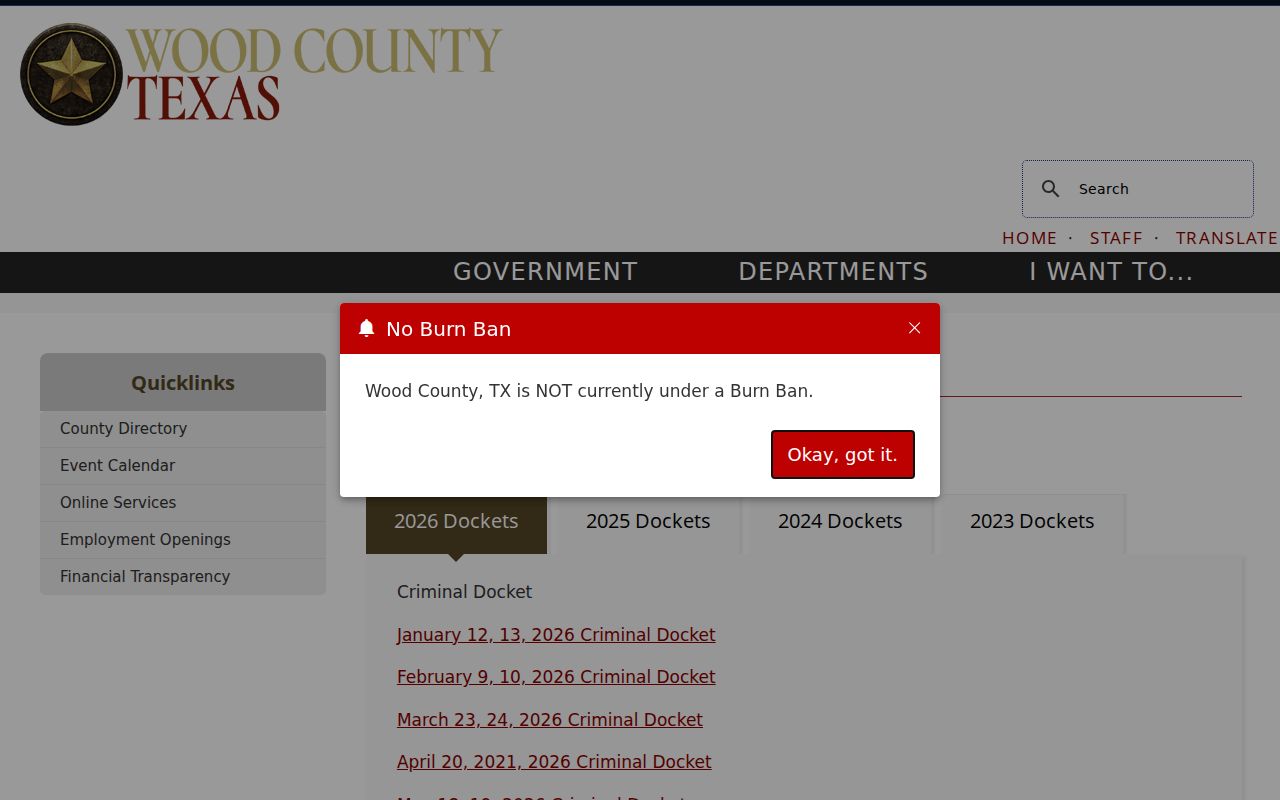
For an imminent setting, confirm with the handling court, attorney, or bondsman. A copied schedule can become stale after a reset. The cause detail remains the route to the larger case history, while a posted docket is chiefly a scheduling aid.
Inside a Wood County Case File
A case index summarizes the file. It does not promise access to each document. Wood County case details may show the cause number, court, filing date, case type, status, parties, attorneys, charge, degree or class, event descriptions, settings, outcome, sentence, costs, balance, bond activity, and enabled document links. Sensitive identifiers and protected party information may be redacted.
| Cause Number and Court | The stable identifier and the court that owns the case. |
|---|---|
| Charging Document | A complaint, information, or indictment stating the filed accusation. |
| Docket Events | Dated filings, hearings, motions, pleas, resets, and rulings. |
| Settings | The listed date, time, and hearing type, subject to later change. |
| Disposition and Judgment | The charge outcome and the court's formal decision. |
| Sentence and Financials | Any sentence, community supervision, fine, costs, restitution, or balance entered. |
The judgment and sentence answer questions that a jail listing cannot. If a document link is absent, contact the clerk instead of assuming the document does not exist.
Order Wood County Court Records
For a certified felony judgment, identify the exact cause in Tyler, mark the document on or with the District Clerk records-request form, and choose certified paper copy. The form accepts requests by email at district.clerk@mywoodcounty.com, fax at 903-763-1511, mail to P.O. Box 1707, Quitman, TX 75783, or the courthouse counter. It asks for the requestor's contact details, cause number, party name, copy type, quantity, and a specific description.
The clerk asks requesters to allow up to ten business days, though Texas public-record timing rules do not turn that phrase into a universal production deadline. The form does not publish copy prices. Ask for a quote, state whether an electronic or paper copy will work, and confirm whether the County Clerk is the custodian for a misdemeanor. A narrow request for a named judgment or docket is easier to process than a demand for every record about a person.
How a Criminal Case Moves
After an arrest, Article 15.17 magistration occurs without unnecessary delay and generally within 48 hours. The prosecutor then screens the event. A misdemeanor can proceed by complaint or information, while a felony usually reaches court through a grand jury indictment. Arraignment presents the accusation and takes a plea. Discovery, motions, settings, a plea or trial, and judgment follow as the facts require.
Case flow: Charges Filed › Arraignment › Pretrial › Plea or Trial › Disposition › Sentencing
The Criminal District Attorney provides defense discovery under Article 39.14. That material is not the same as the public clerk index. A reader focused on the public outcome should follow the filed charge through disposition and sentence. For the earlier custody event, the separate Wood County arrest lookup explains the jail and arresting-agency records.
Read Wood County Case Events
Short court terms can change the meaning of a Wood County criminal case. A dismissal is not a conviction, but it also does not automatically erase the arrest or booking entry. Deferred adjudication places a person on supervision without an immediate finding of guilt; successful completion does not itself remove all public traces. A no-bill means the grand jury declined an indictment.
- Arraignment
- The proceeding where the accusation is presented and a plea is taken.
- Disposition
- The outcome of a charge, such as conviction, dismissal, acquittal, or deferred adjudication.
- Information
- A prosecutor-filed charging instrument commonly used for a misdemeanor.
- Indictment
- A grand jury's formal felony accusation, also called a true bill.
- Capias
- Court process directing an arrest, often after a case event or judgment.
Note: Compare the filed charge and final disposition rather than treating an arrest label as the settled Wood County court outcome.
Case Record Access & Restrictions
Texas court-record access follows judicial rules rather than treating every clerk file as an ordinary executive-branch request under the Texas Public Information Act. Texas judiciary access standards supply the broader framework. Public indexes may still omit documents, and protected material may be sealed or redacted. Juvenile records, victim details, medical data, driver's-license numbers, Social Security numbers, and other sensitive identifiers do not become public merely because a case exists.
Texas Code of Criminal Procedure Chapter 55A governs expunction. Orders of nondisclosure arise under Government Code Chapter 411. These remedies differ. Expunction can direct destruction or return of qualifying records, while nondisclosure restricts ordinary public release but preserves listed government access. Neither remedy should be inferred from a blank online result.
The Wood County expunction page is unusually useful because it lists local custodians and the four rotating justice courts that may have handled magistration. This official image captures that county-specific agency guidance.
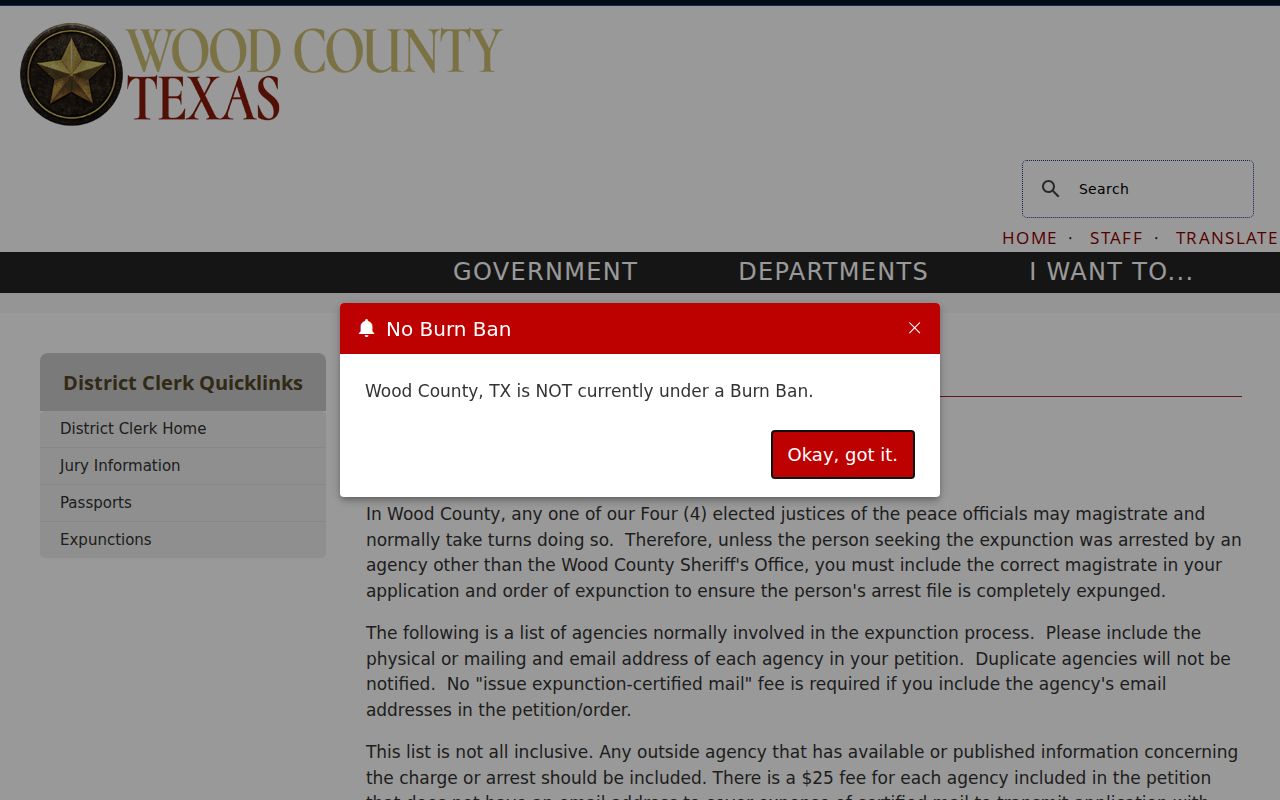
An omitted magistrate or agency can leave a copy behind. The page also notes a $25 certified-mail transmission charge for each listed agency without an email address.
Wood County Cases and DPS
The local Tyler index and the Texas Department of Public Safety product answer different questions. Tyler documents Wood County proceedings. The DPS Public Criminal History Conviction Search returns the public statewide subset authorized by Government Code §411.135, chiefly reported convictions and deferred adjudications. It needs an account and prepaid credits. A search costs one $1 credit, including a no-match, and name or birth-date matching is not positive identification.
The DPS matching instructions explain Soundex, exact and partial matches, previews, and search credits. This image shows that official help channel.

A DPS return can lag a local disposition or omit an event outside its public category. When identity or accuracy matters for one's own record, fingerprints are the stronger comparison method. Texas FAST fingerprint appointments run through IdentoGO with an agency service code. The appointment screen shown here is the official entry point for that process.
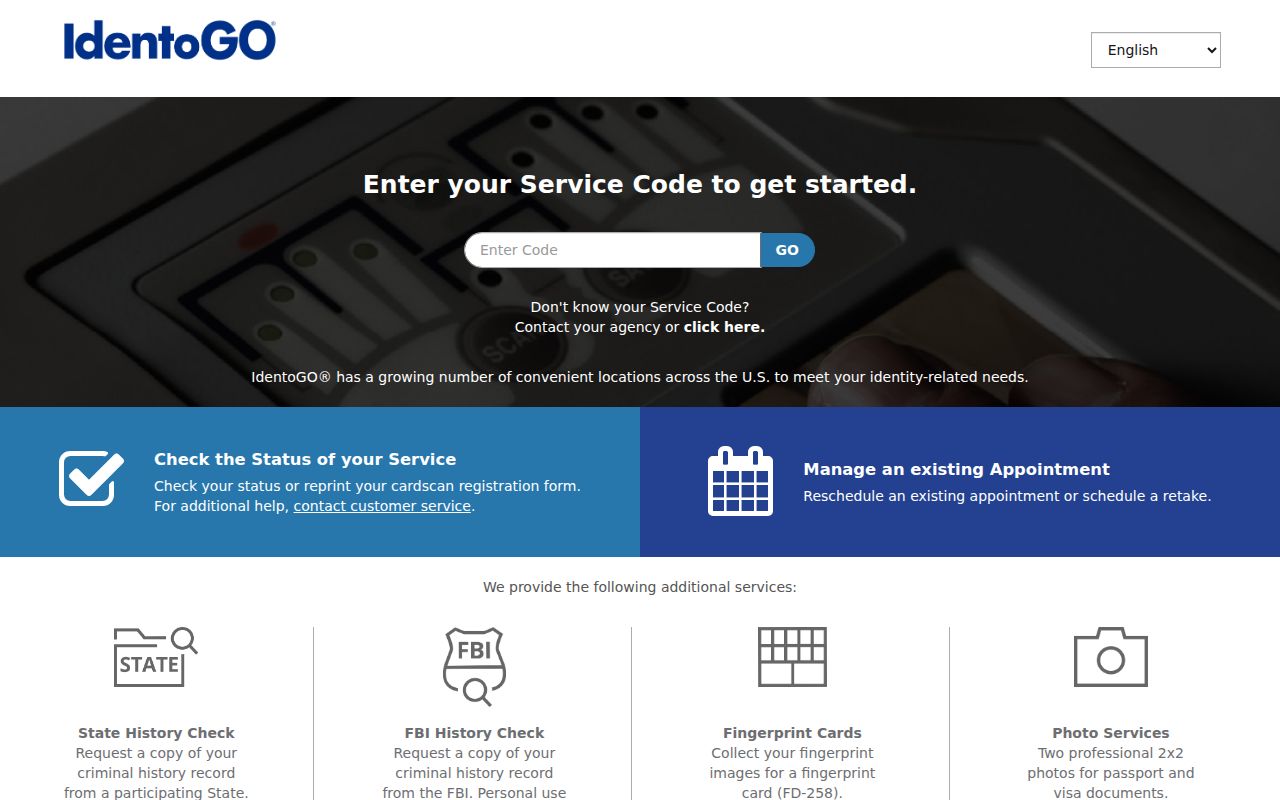
The service code controls the authorized purpose and total price. A personal DPS review can help test a disputed name match, but the originating Wood County clerk may still need to correct a wrong disposition.