
Sex Offender Checks in Wood County
The official starting point is the Texas Public Sex Offender Registry. Wood County government links residents to that state system instead of operating a separate county list. Texas DPS controls the public search and the information displayed there. Local law enforcement registers and verifies people who have a reporting duty, but a Wood County sex offender search still runs through DPS. This division matters when a record seems stale: the registry is the place to read the public entry, while the local registration authority is the place to raise a compliance concern.
Choose a search method based on what is known. A well-supported name can lead to a direct match. An address, city, ZIP code, or Wood County filter is more useful for community awareness near a place. Either route requires care because similar names can refer to different people, and an address is a reported registration point rather than live location data. Compare several identifiers. Read the status and last update. Do not rely on one matching name or map marker.
DPS Runs Wood County Registry Search
The county's official online-services page sends searchers to DPS and states that the information is controlled by the state. That makes the custodian clear. Wood County does not republish a parallel roster, and no county-specific registry alert app was verified in the research. A claimed local list, app, or private directory should not replace the state source. The public DPS database is the authoritative web channel for Texas registration entries.
The Wood County Online Services gateway also helps confirm that the registry link is an official route. If the DPS interface changes, begin there rather than following an old bookmark. Questions about a suspected reporting failure can go to the Wood County Sheriff's Office at 903-763-2201. The sheriff can address local procedure or receive a report, but staff cannot turn the registry into a guarantee of a person's present location.
Note: A registry no-hit does not prove that no registration record exists in another state, county, spelling, or location search.
How to Search the Texas Public Sex Offender Registry
DPS offers name and geographic modes. Start narrow when identity is known, then widen the terms only if the first attempt fails. For a place-based Wood County registry review, select the county or use a city, ZIP code, or address field that is displayed. Radius choices can change with the live interface, so use only the values shown on screen. The search form itself is the best source for current controls.
- Open the DPS registry and read its conditions of use before submitting a search.
- Choose name or geographic search, then enter the strongest known fields or select Wood County.
- Review the result list without treating a shared name or nearby marker as a confirmed match.
- Open the public profile and compare its photo, physical details, offense, registration status, and update information.
| Field Label | Type | Required | Notes |
|---|---|---|---|
| Search by | Tab or radio | Yes | Choose name or geographic/location mode. |
| Last Name | Text | Conditional | Used for a name search. |
| First and Middle Name | Text | No | Can narrow a name match. |
| Address | Text | Conditional | Supports a geographic search by street, city, or ZIP. |
| City or County | Text or dropdown | No | Select Wood for countywide results when offered. |
| ZIP Code and Radius | Text and dropdown | No | Use the live radius options rather than assuming a distance. |
| Map or List | View control | No | Switches the results display where offered. |
If a broad Wood County search returns many entries, add a city, ZIP code, or exact address instead of guessing from the first result. For a name search, use first and middle names only to narrow the list because records may omit a middle name or carry an alias. Reset the form before changing modes so an old geographic filter does not shape a new name query.
Name and Address Searches in Wood County
A name search and an address search answer different questions. Use a name when there is a sound basis for identity, then check aliases and descriptive fields. Use a Wood County location search for awareness around a home, school route, park, or other place without assuming that each result presents the same type of risk. The registry gives notice of legal registration facts. It does not rank people by a simple consumer risk score.
The official DPS registry search screen shows the neutral fields readers use before any profile is opened.
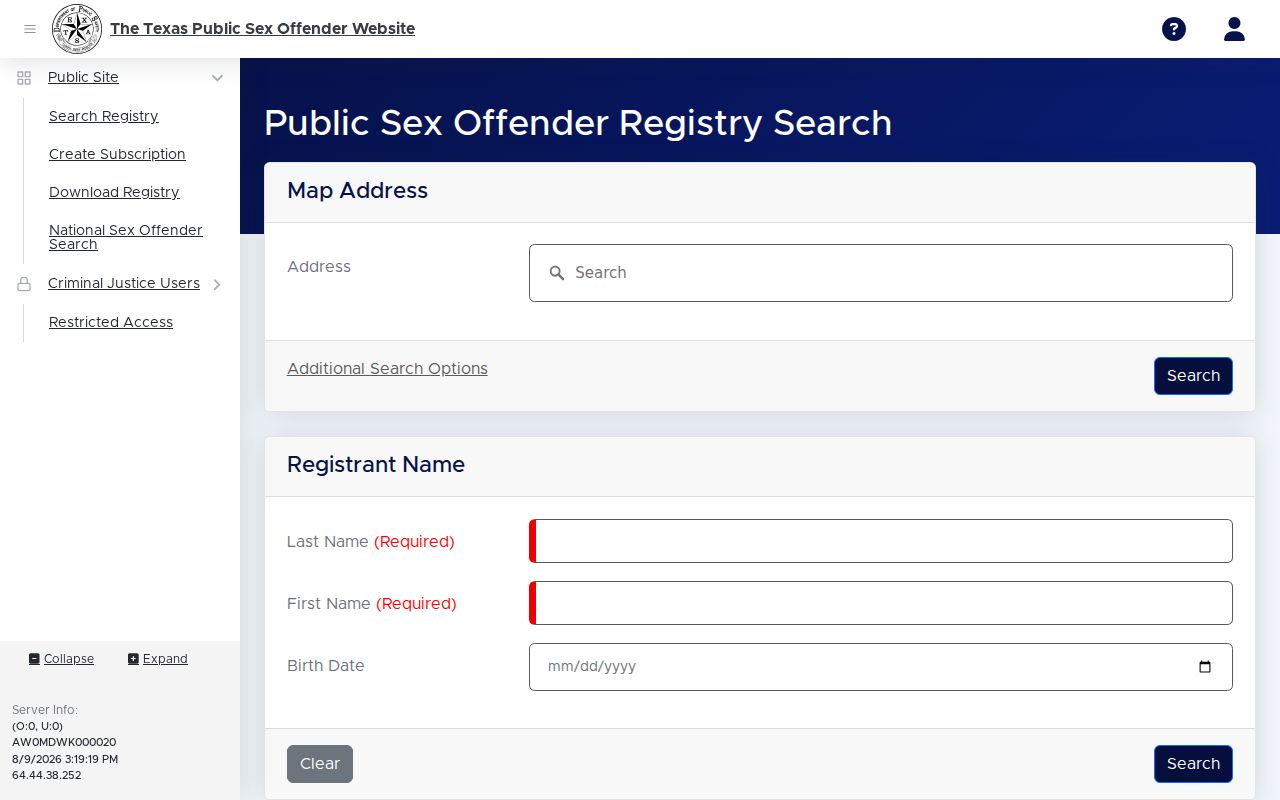
This blank search view keeps the focus on method and avoids making any private registrant the visual subject. Exact address geocoding and map controls depend on the current interface. If a result appears close to a county line, do not assume the Wood County filter alone captures nearby registrations in another jurisdiction.
Inside a Wood County Registry Profile
A public profile joins identity, appearance, offense, and registration facts in one entry. Read those groups together. The name and photo help avoid a false match, while status and verification fields show how the entry is being maintained. Offense text describes the reportable adjudication or conviction. It does not state that a new offense occurred at the registered address. Some statutory fields may appear only when Texas law calls for public display.
| Name and Aliases | Current listed name and other names tied to the registration record. |
|---|---|
| Photo and Description | Photo, sex, race, age or birth data, height, weight, hair, eyes, and listed marks or tattoos. |
| Registered Location | Reported residence or location description, plus city and county information. |
| Offense Information | Offense description or statute, adjudication date, and victim age or sex category when displayed by law. |
| Registration Duty | Start, end, lifetime, or verification details tied to the person's statutory category. |
| Status and Update | Registration status, reporting agency, verification requirement, and last update where shown. |
| Other Public Fields | Vehicle, institution, or education details may appear when the statute permits them. |
Read the update date before using the address in a safety plan. A profile can be accurate as a reported record without showing where someone is at the moment. Contact the reporting agency when a status term is unclear.
NSOPW Beyond Wood County Lines
Wood County sits within a wider region where a short drive can cross a county line, and prior residence can involve another state. The National Sex Offender Public Website, operated by the U.S. Department of Justice, searches participating jurisdictions as a supplement to the Texas registry. It is useful when a Wood County address search should also account for nearby places or when the state tied to a record is uncertain.
The national portal's cross-state search interface shows how participating registry sources can be reached from one official federal starting point.
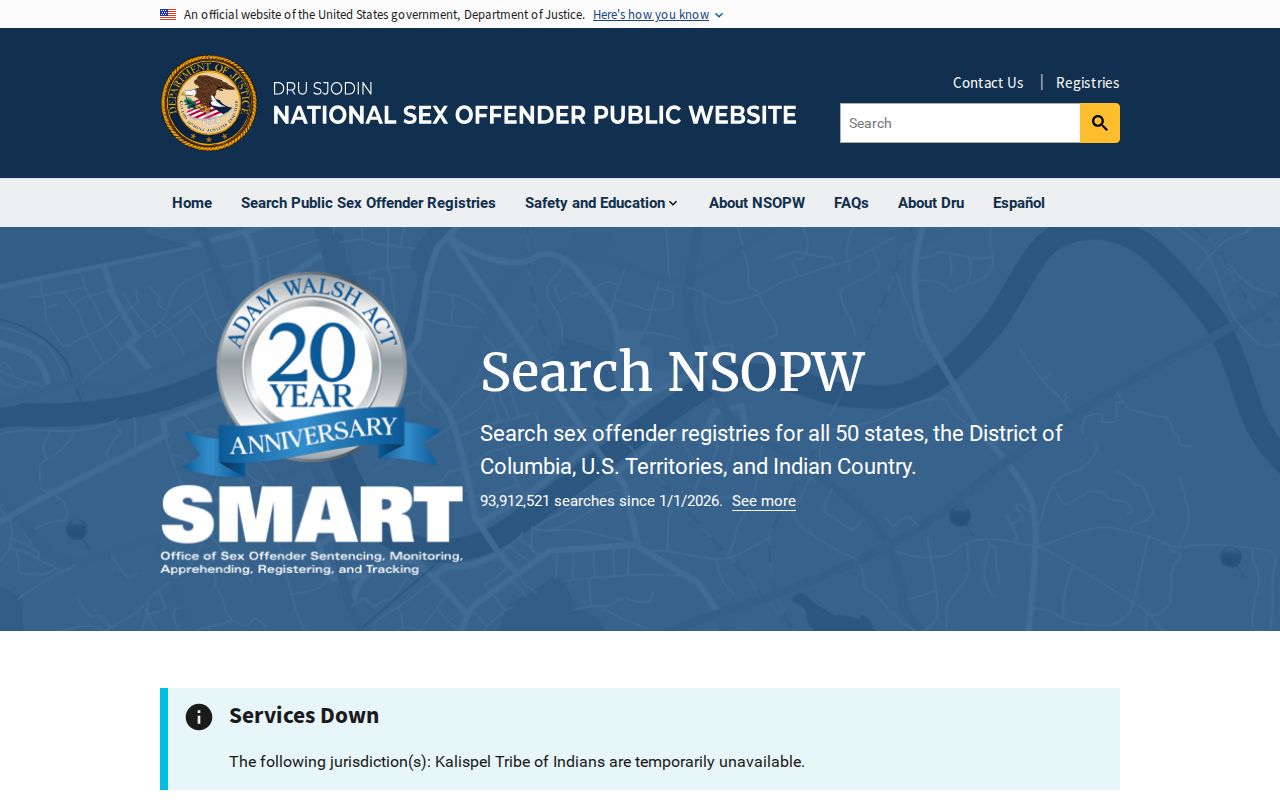
Use NSOPW to broaden the geography, then confirm Texas details in the DPS profile. Different states use different labels and display rules, so a result from elsewhere should not be forced into Texas terminology. A national search is also subject to the participating registry's update process.
Texas Registration Levels and Requirements
Texas does not present every public registration record through a simple Level 1, Level 2, and Level 3 consumer scheme. Code of Criminal Procedure Chapter 62 ties the duty to the offense, judgment, release or supervision history, and other statutory facts. Many reportable convictions require registration for ten years after release or supervision. Enumerated sexually violent, repeat, and other offenses can require lifetime registration. Juvenile provisions and risk assessments follow separate rules.
| Texas Category | Duration | Verification |
|---|---|---|
| Many reportable convictions | Ten years after release or supervision, when Chapter 62 so provides | Often annual, based on the governing provision and status |
| Enumerated lifetime categories | Lifetime registration | Annual, 90-day, or another statutory schedule may apply |
| Juvenile or special provisions | Determined under the applicable Texas rule or court action | Depends on the person's legal category |
The profile and the exact Chapter 62 provision control. Federal SORNA tiers should not be substituted for Texas public labels. A Wood County record with a 90-day verification schedule should be read as that person's legal duty, not as a shorthand forecast of conduct.
Wood County Address and Update Limits
A registered address is a required report, not a live tracking signal. Compare it with the last verification and update fields before relying on it. A recent move, data-processing delay, incomplete geocoding, or a location description instead of a standard street address can affect what appears. When a search looks wrong, check spelling and location filters first. Then use an official contact rather than approaching the person at the listed place.
No verified countywide distance ordinance was found for Wood County. Texas restrictions may instead arise from a person's supervision conditions or from a municipal rule. Do not infer a fixed school, park, or child-care buffer for all registrants. The lawful distance, if any, must come from the rule that applies to that person and place. Likewise, no Wood County sheriff registry alert app was verified, so any alert option should be used only when it is currently displayed by DPS or NSOPW.
Note: A map marker can guide awareness, but the registry profile and its dates supply the context needed to read that marker.
Report Noncompliance in Wood County
Suspected noncompliance should be reported, not investigated by a resident. Save the public profile link or note the relevant public details, explain what seems inconsistent, and call the Wood County Sheriff's Office at 903-763-2201. The office can route the information to the proper local authority or explain its registration procedure. For an urgent threat, use the appropriate emergency channel. A stale address by itself does not establish a crime, so describe the observed concern without adding assumptions.
Do not confront, follow, photograph, or post accusations about a person or household. Registry verification is a law-enforcement task. The same caution applies when the profile shows a status label that is unfamiliar. Ask the reporting agency what the label means rather than treating it as proof of present conduct.
Community Notification and Lawful Use
Public registration information supports personal, family, and neighborhood safety decisions. It can help a resident understand a reported location, review an official offense entry, or plan a route with more context. It cannot say whether a person will offend again. Nor does a result replace current facts about an emergency. Treat each entry as a government notification record with legal limits, not a score or an invitation to act against someone.
Chapter 62 governs the public database and registration duties. DPS and local law enforcement update the official channels. Sharing only what is needed for a lawful safety purpose reduces the risk of mistaken identity and needless harm, especially where names, household members, or neighboring addresses can be confused.
Use Registry Data Lawfully: Under Texas Code of Criminal Procedure Chapter 62, registry information must not be used to threaten, harass, or commit a crime. Misuse can bring criminal or civil consequences.